Balanced Pressure Thermostatic Steam Trap L21S / L32S – Fail-Open Design for Industrial Steam Systems
23/02/2026In industrial steam systems, efficient condensate removal without live steam loss is critical to maintaining heat transfer performance and operational safety. The L21S/L32S Balanced Pressure Thermostatic Steam Trap is engineered with precise temperature-controlled operation and a fail-open safety design, ensuring reliable condensate discharge, reduced water hammer risk, and long-term protection of equipment under high-pressure and high-temperature conditions.
1. Product Overview
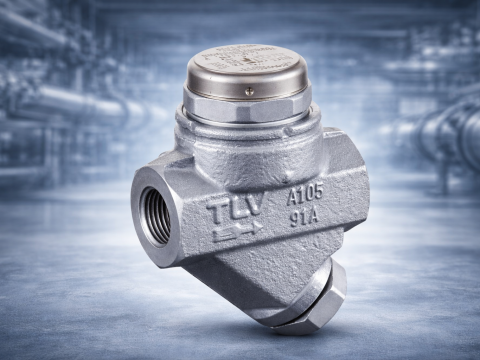
The Balanced Pressure Thermostatic Steam Trap is designed to automatically discharge condensate from steam systems without allowing live steam loss.
Models L21S and L32S are engineered for a wide range of industrial applications, including:
- Steam mains
- Steam tracing systems
- Dryers
- Process heaters
With a forged steel body construction, these models provide high durability and reliable performance under demanding pressure and temperature conditions.
2. Operating Principle – Balanced Pressure Thermostatic Mechanism
The balanced pressure thermostatic steam trap operates based on the temperature difference between saturated steam and condensate.
Inside the trap, a temperature-sensitive X-element (C6) contains a specially formulated liquid. The operating cycle is as follows:
- When cool condensate enters the trap → the element contracts → the valve opens → condensate is discharged.
- When steam approaches saturation temperature → the element expands → the valve closes → live steam is retained.
This cyclic operation ensures controlled condensate discharge at a consistent subcooling level (up to 6°C below saturation temperature).
3. Fail-Open Design – Operational Safety Advantage
The Fail-Open design ensures that, in the unlikely event of element failure, the valve remains in the open position.
Key advantages:
- Prevents condensate accumulation in the steam space
- Reduces risk of water hammer
- Protects downstream heat transfer equipment
- Enhances overall system safety
This is a significant advantage compared to traps that may fail closed, potentially causing dangerous condensate backup.
4. Key Features of Models L21S / L32S
- Forged steel body construction
- Stable cyclic operation across the full pressure range
- Does not retain condensate in the steam space
- Excellent air venting capability
- Resistant to superheat and water hammer
- Compact design with high discharge capacity
- Hardened stainless steel valve seat
- Built-in strainer with large surface area
- Easy cleaning and maintenance
- Optional built-in check valve available
5. Technical Specifications
| Specification | L21S | L32S |
|---|---|---|
| Nominal Sizes | 15, 20, 25 mm | 15, 20, 25 mm |
| End Connections | Screwed, Socket Welded, Flanged | Screwed, Socket Welded, Flanged |
| Max. Operating Pressure (PMO) | 2.1 MPaG | 3.2 MPaG |
| Min. Operating Pressure | 0.01 MPaG | 0.01 MPaG |
| Maximum Back Pressure | 90% of inlet pressure | 90% of inlet pressure |
| Subcooling | Up to 6°C | Up to 6°C |
| X-element Type | C6 | C6 |
6. Operating Limits
- Maximum Allowable Pressure (PMA): 3.2 MPaG
- Maximum Allowable Temperature (TMA): 300°C
- Operating temperature follows the saturated steam pressure curve.
These limits ensure suitability for medium- to high-pressure industrial steam systems.
7. Construction & Materials
Major components are manufactured using high-quality materials:
- Body & Cover: Carbon Steel (ASTM A105 equivalent)
- Valve Seat: Stainless Steel SUS420F
- X-element: Stainless Steel SUS304
- Gasket: Graphite / SUS316L
- Strainer: SUS304 / SUS430
This robust material selection ensures:
- Long service life
- High corrosion resistance
- Strength under high pressure and temperature
- Reduced maintenance costs
8. Typical Applications
The L21S/L32S steam traps are suitable for:
- Steam distribution mains
- Steam tracing lines
- Heat exchangers
- Industrial dryers
- Tank heating systems
Their superior air venting capability makes them especially effective during system start-up conditions.
9. Comparison with Other Steam Trap Types
| Criteria | Thermostatic (L21S/L32S) | Mechanical | Thermodynamic |
|---|---|---|---|
| Air Venting at Start-up | Excellent | Moderate | Limited |
| Temperature Sensitivity | High | Low | Low |
| Superheat Resistance | Good | Moderate | Good |
| Fail-Safe Behavior | Fail-Open | Design dependent | Not guaranteed |
| Suitability for Tracing | Highly suitable | Not optimal | Not recommended |
10. System Benefits
By installing the L21S / L32S balanced pressure thermostatic steam trap, you can achieve:
- Improved heat transfer efficiency
- Reduced water hammer risk
- Minimized live steam loss
- Enhanced operational safety
- Extended equipment lifespan
- Lower long-term maintenance costs
11. Conclusion
The L21S / L32S Balanced Pressure Thermostatic Steam Trap provides a reliable and safe condensate removal solution for industrial steam systems requiring:
- Accurate temperature-based condensate discharge
- Excellent air venting performance
- Fail-Open operational safety
- High durability under demanding pressure conditions
It is an ideal solution for industries such as food processing, textiles, chemicals, power generation, and general manufacturing.