WONIL STAINLESS STEEL BUTTERFLY VALVE – WAFER-TYPE BUTTERFLY VALVE WITH LEVER AND GEAR OPERATION
05/09/2026In industrial piping systems, butterfly valves are one of the most commonly used devices for flow shut-off and regulation thanks to their compact design, light weight, and fast operation. In particular, for systems handling water, clean water, chemicals, or media requiring high corrosion resistance, stainless steel butterfly valves are a suitable choice to improve system durability and operational stability.
Wonil is an industrial valve brand from South Korea, supplying various valve product lines for water supply and drainage systems, water treatment, chemical applications, and industrial systems. Among them, the Wonil stainless steel wafer-type butterfly valve is designed with an SSC13 stainless steel body, SSC13 valve disc, and PTFE sealing seat, meeting the requirements of various operating conditions.
The product has two main operating methods:
- WSBL-1: lever acting.
- WSBG-1: gear acting.
- In addition, the WSBG-16 series uses a gear-operated handwheel mechanism and offers a larger size range.
1. Overview of Wonil Stainless Steel Butterfly Valve
The Wonil stainless steel butterfly valve is a flow shut-off valve that uses a circular disc mounted on a stem. When the valve stem rotates, the disc rotates accordingly and changes the flow passage area through the pipeline.
Unlike butterfly valves with cast iron or conventional material bodies, the valve series in the technical documentation is designed with an SSC13 body – a cast stainless steel material, while the valve disc is also made of SSC13. The sealing component uses PTFE, making the valve suitable for applications requiring corrosion resistance and relatively high sealing performance.
The valve uses a wafer-type connection, allowing installation between two pipeline flanges. This is one of the important advantages of butterfly valves because the wafer design generally provides a short face-to-face dimension, saves installation space, and reduces the overall weight of the system.
The product series is available in various sizes, from approximately 40A to 300A for the conventional lever/gear-operated versions and can be extended up to DN600 for the WSBG-16 series.
Depending on the pipeline size and required operating torque, users can select:
- Lever-operated butterfly valves for small systems requiring fast operation.
- Gear-operated butterfly valves for larger sizes or locations where operating force needs to be reduced.
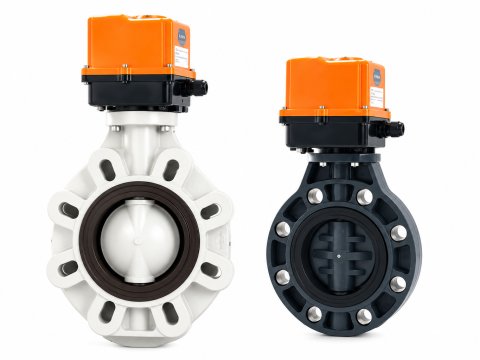
- Automatically actuated butterfly valves when integration with a control system is required.
2. Construction of Wonil Stainless Steel Butterfly Valve
One of the factors determining the operating performance of a butterfly valve is the construction of the valve body, disc, stem, and sealing components.
According to Wonil’s technical drawing, the valve consists of the following main components:
2.1. Valve Body – Body
The valve body uses SSC13, which belongs to the cast stainless steel group. The valve body is the main pressure-containing component and is directly connected to the piping system.
The use of stainless steel provides better corrosion resistance compared with valve bodies made of cast iron or carbon steel in suitable environments.
The valve body is designed in a wafer type, without requiring a long flanged valve body. During installation, the valve is positioned between the two pipeline flanges and secured with a bolting system.
2.2. Valve Disc – Disc
The valve disc is the component that directly contacts the process medium and performs the function of opening or shutting off the flow.
The disc of this valve series is manufactured from SSC13, providing increased corrosion resistance and making it suitable for systems handling water, industrial water, and certain chemical media.
When the valve is closed, the disc rotates to a position perpendicular to the flow direction and forms a flow-blocking surface. When the valve is fully open, the disc rotates to a position nearly parallel to the flow, providing a large flow passage area.
2.3. Valve Stem – Stem
The valve stem transmits motion from the operating mechanism to the valve disc.
When the operator applies force to the lever or handwheel, the motion is transmitted through the stem, causing the valve disc to rotate to the desired angle.
According to the technical documentation, the stem uses STS304 material, providing increased corrosion resistance under suitable operating conditions.
2.4. Sealing Seat – Seat
One of the notable features of this valve series is the PTFE sealing material.
PTFE has good chemical resistance and a low coefficient of friction, and is therefore commonly used in applications requiring sealing performance and corrosion resistance.
The selection of the seat material should be based on:
- Type of process medium.
- Chemical concentration.
- Operating temperature.
- Operating pressure.
- Actual operating conditions.
The valve material alone should not be considered without also evaluating the chemical compatibility of the sealing seat with the process medium.
3. Operating Principle of Wonil Butterfly Valve
The butterfly valve operates based on the rotational movement of the disc around the stem.
When the valve is fully closed, the disc is positioned nearly perpendicular to the flow direction. The disc surface, together with the sealing component, creates a flow-blocking condition.
When the valve begins to open, the disc rotates around the stem. The larger the opening angle, the greater the flow passage area.
When the valve is fully open, the disc rotates to a position nearly parallel to the flow direction, allowing the process medium to pass through the valve with lower resistance than in the closed condition.
The valve can be operated by two methods:
Lever Acting
For the WSBL-1 model, the valve is operated directly by a lever.
This operating method offers the following advantages:
- Fast operation.
- Simple construction.
- Easy identification of the open/closed status.
- Suitable for small and medium-sized pipelines.
Gear Acting
For the WSBG-1/WSBG-16 models, the valve uses a handwheel combined with a gear mechanism.
As the valve size increases, the torque required to rotate the valve disc also increases. The gear mechanism reduces the operating force required from the operator to open or close the valve.
Therefore, the gear-operated configuration is particularly suitable for:
- Large-diameter pipelines.
- Valves installed in locations that are difficult to access.
- Systems requiring gradual opening/closing operation.
- Applications requiring more precise operation control.
4. Two Operating Options: Lever and Gear
Wonil provides stainless steel butterfly valves with two common operating methods, allowing users to select according to the valve size and system operating requirements.
4.1. Wonil WSB L-1 Lever-Operated Butterfly Valve
The WSBL-1 uses a lever to directly control the position of the valve disc.
According to the dimensional table in the technical documentation, the WSB L-1 series is available in sizes from 40A to 200A, while some larger sizes may be available according to the specific product configuration.
The lever-operated version is suitable for systems requiring frequent opening and closing and fast operation.
Some advantages include:
- Simple design.
- No gear mechanism required.
- Fast operation.
- Easy valve status identification.
- Suitable for limited installation spaces.
4.2. Wonil WSBG-1 Gear-Operated Butterfly Valve
The WSBG-1 uses a gear-acting mechanism, consisting of a handwheel combined with a gearbox.
Compared with the lever-operated type, this configuration is more suitable for larger valves or applications requiring higher operating torque.
According to the documentation, the WSBG-1 is available in sizes from 40A to 300A.
For large-diameter piping systems, the handwheel operation allows the operator to open and close the valve more conveniently while reducing the direct operating force applied to the stem.
5. Technical Specifications of Wonil Stainless Steel Butterfly Valve
The following specifications are compiled from the provided technical documentation for the Wonil butterfly valve series:
| Specification | WSB L-1 | WSBG-1 |
|---|---|---|
| Model | WSB L-1 | WSBG-1 |
| Operating method | Lever acting | Gear acting |
| Applicable medium | Water | Water |
| Maximum applicable pressure | 0.98 MPa | 1.6 MPa |
| Maximum temperature | 180°C | 180°C |
| Connection type | Wafer | Wafer |
| Seat test pressure | 1.1 MPa | 1.1 MPa |
| Body test | 10K, water | 10K, water |
| Valve body | SSC13 | SSC13 |
| Disc/Trim | SSC13 | SSC13 |
| Seat | PTFE | PTFE |
Note: Actual pressure and temperature ratings shall be confirmed according to the exact model, size, configuration, and process conditions before selecting the valve for a system.
Reference Size Range
The WSB L-1/WSBG-1 series is shown in the documentation with the following sizes:
40A → 50A → 65A → 80A → 100A → 125A → 150A → 200A → 250A → 300A.
For the WSBG-16 series, the documentation indicates a wider size range:
40A to DN600.
This allows the valve series to be used from small pipeline systems to large-scale industrial piping systems.
6. Advantages of Wonil Stainless Steel Butterfly Valve
6.1. SSC13 Stainless Steel Valve Body
SSC13 provides good corrosion resistance in suitable applications, particularly when compared with conventional materials such as cast iron or carbon steel.
This is a notable advantage for systems such as:
- Industrial water systems.
- Process water systems.
- Certain chemical media.
- Systems requiring high corrosion-resistant materials.
6.2. Stainless Steel Valve Disc
The valve disc is in direct contact with the process medium, so the disc material plays an important role.
The use of SSC13 increases the durability of the disc and helps minimize corrosion-related issues under suitable operating conditions.
6.3. PTFE Seat
PTFE provides resistance to many types of chemicals and has a low coefficient of friction.
For this reason, PTFE is commonly selected for valve designs requiring good sealing performance and chemical compatibility.
However, the specific chemical compatibility should be checked before use.
6.4. Compact Wafer Design
The wafer valve has a short face-to-face dimension, helping save installation space.
This advantage is particularly useful in systems such as:
- Water treatment plants.
- HVAC systems.
- Pump stations.
- Industrial water systems.
- Piping systems with limited installation space.
6.5. Multiple Operating Options
Users can select either lever or gear operation depending on the valve size and operating requirements.
For systems requiring automation, the valve configuration can also be considered for integration with a suitable actuator.
7. Applications of Wonil Stainless Steel Butterfly Valve
Thanks to the stainless steel body and disc combined with a PTFE seat, Wonil butterfly valves can be applied in various industrial systems.
7.1. Water Supply Systems
The valve can be used to open/close water supply pipelines, distribution lines, and locations requiring flow isolation.
The wafer design helps save space and facilitates the arrangement of multiple valves within the same system.
7.2. Water Treatment Systems
In water treatment plants, butterfly valves are used at various locations such as:
- Inlet water lines.
- Treated water lines.
- Filtration lines.
- Treatment tanks.
- Pump stations.
- Water distribution systems.
7.3. Industrial Water Systems
Production lines often have multiple cooling water, process water, or circulating water pipelines.
Stainless steel butterfly valves can be used at locations requiring equipment isolation or flow opening/closing.
7.4. Chemical Systems
The stainless steel body and disc combined with a PTFE seat allow the valve series to be considered for certain chemical applications.
However, this is an application that requires particular attention to material compatibility. Not all chemicals are suitable for SSC13 or PTFE.
When selecting the valve, the following information should be provided:
- Chemical name.
- Concentration.
- Temperature.
- Pressure.
- Flow rate.
- Actual operating conditions.
7.5. Clean Water Systems
The valve series can be used in clean water systems or systems requiring high corrosion-resistant materials, subject to the technical standards and hygienic requirements of each project.
8. Guidelines for Selecting the Appropriate Wonil Butterfly Valve
Valve selection should not be based solely on pipeline size. Several important parameters need to be determined before ordering.
8.1. Determine the Pipeline Size
First, determine the DN/size of the pipeline.
Common sizes in the product series include:
40A → 50A → 65A → 80A → 100A → 125A → 150A → 200A → 250A → 300A
and the WSBG-16 series can extend up to DN600.
8.2. Determine the Process Medium
The exact valve service medium should be identified:
- Water.
- Treated water.
- Industrial water.
- Chemicals.
- Other liquid media.
For chemical applications in particular, the compatibility between the process medium and SSC13 and PTFE must be checked.
8.3. Determine the Pressure
The valve should not be selected based solely on size.
It is necessary to determine:
Actual operating pressure ≤ allowable pressure of the model.
In addition to normal operating pressure, abnormal conditions such as pressure fluctuations or water hammer should also be considered.
8.4. Determine the Temperature
The process medium temperature directly affects the sealing performance of the seat.
According to the provided documentation, the maximum applicable temperature of the product series can reach 180°C, depending on the model/configuration.
However, when operating at high temperatures, the temperature limits of all valve materials and the complete valve configuration should be checked simultaneously.
8.5. Select Lever or Gear Operation
The following principle can be used as a reference:
Lever acting → suitable for small valves requiring fast operation.
Gear acting → suitable for larger valves requiring reduced operating force.
The final selection should be based on the actual operating torque and installation conditions.
9. Installation Notes for Wafer-Type Butterfly Valve
Wafer-type butterfly valves are installed between two flanges, so particular attention should be paid to the alignment and concentricity of the piping.
Step 1: Inspect the Valve Before Installation
Check:
- Valve body.
- Valve disc.
- Valve stem.
- Seat.
- Lever/gear mechanism.
- Connection surfaces.
Do not use the valve if deformation or damage is found.
Step 2: Check the Flanges
The two flanges must be:
- Parallel.
- Concentric.
- Free from deformation.
- Free from obstructions.
The distance between the two flanges must be sufficient to insert the valve without applying excessive force to the valve body.
Step 3: Position the Valve Correctly
Place the valve between the two flanges and align the valve stem with the desired operating direction.
The valve should not be used as a tool to pull the two flanges together.
Step 4: Tighten the Bolts
Tighten the bolts in a crosswise sequence and gradually increase the tightening force.
Uneven tightening may cause valve body misalignment or affect sealing performance.
Step 5: Check Operation
After installation, operate the valve several times to check:
- Whether the disc moves normally.
- Whether the lever/gear mechanism is free from jamming.
- Whether there is any contact between the disc and the pipeline.
- Whether the open/closed positions are accurate.
10. Operating and Maintenance Notes
To ensure stable operation and extend the service life of the Wonil butterfly valve, periodic inspection should be carried out.
Check for Leakage
Check the following locations:
- Seat.
- Flanges.
- Valve body.
- Valve stem area.
If abnormal leakage occurs, the cause should be identified before continuing operation.
Check the Operating Mechanism
For lever-operated valves, inspect the lever and locking mechanism.
For gear-operated valves, inspect the condition of the gearbox and the ability of the handwheel to rotate.
Excessive force or auxiliary tools should not be used to forcibly operate the valve if the valve is jammed.
Check the Process Medium
If the system changes the chemical type or the operating temperature/pressure conditions, the compatibility of the valve materials should be reassessed.
Periodic Inspection
The inspection frequency depends on:
- Operating environment.
- Opening/closing frequency.
- Temperature.
- Pressure.
- Characteristics of the process medium.
- Criticality of the system.
For critical systems, a preventive maintenance plan should be established rather than performing repairs only after valve failure occurs.
11. Comparison Between Wonil Lever-Operated and Gear-Operated Butterfly Valves
| Criteria | WSB L-1 – Lever Acting | WSBG-1 – Gear Acting |
|---|---|---|
| Mechanism | Direct lever operation | Gearbox + handwheel |
| Operation | Fast | Slower and better controlled |
| Operating force | Higher for larger valves | Reduced through gearbox |
| Suitable for | Small/medium sizes | Medium/large sizes |
| Space | Compact | Requires space for handwheel |
| Maintenance | Simple | Requires gearbox inspection |
| Application | Piping requiring fast opening/closing | Large piping, high operating torque |
Neither type is universally better than the other. The selection depends on the valve size, installation location, and operating requirements.
12. Why Choose Wonil Stainless Steel Butterfly Valves?
For industrial systems requiring equipment with durability, compact design, and good corrosion resistance, the Wonil stainless steel butterfly valve is a solution worth considering.
The combination of:
SSC13 Body + SSC13 Disc + STS304 Stem + PTFE Seat
provides a configuration suitable for various water applications and certain industrial environments, depending on the actual operating conditions.
In addition, the wafer design helps reduce installation space, while the two operating options, WSB L-1 lever acting and WSBG-1 gear acting, allow users to select an operating method appropriate for each system.
For larger pipelines, the WSBG-16 series extends the size range up to DN600, meeting requirements for large-scale industrial piping systems.
13. Conclusion
The Wonil stainless steel butterfly valve is a wafer-type valve designed to meet flow shut-off requirements in water systems and industrial applications.
With an SSC13 valve body, SSC13 valve disc, STS304 stem, and PTFE seat, the product provides a material configuration suitable for systems requiring corrosion resistance and good mechanical durability.
The two options, WSBL-1 lever acting and WSBG-1 gear acting, enable the product to meet various installation and operating requirements. The lever-operated type is suitable for systems requiring fast operation, while the gear-operated type is more suitable for larger valves or applications requiring reduced operating force.
The valve can be applied in water supply systems, water treatment systems, industrial water systems, certain chemical systems, and other industrial piping systems.
When selecting the valve, it is necessary to fully determine the pipeline size, process medium, pressure, temperature, connection type, and operating method to ensure that the valve is correctly selected for the actual system conditions.
ANCES provides consultation and selection solutions for Wonil stainless steel butterfly valves based on the technical specifications of each system, supporting customers in selecting the appropriate model, size, and operating configuration for each industrial application.