VONTRON LP21-4040 LOW-PRESSURE RO MEMBRANE – HIGH-PERFORMANCE LOW-PRESSURE RO MEMBRANE ELEMENT
21/09/20261. Overview of the VONTRON LP21-4040 Low-Pressure RO Membrane
In industrial water treatment systems, Reverse Osmosis (RO) technology is widely used to remove dissolved salts and various undesirable components from water, thereby producing higher-quality water for subsequent treatment processes.
The VONTRON LP21-4040 Membrane Element is a membrane element belonging to the LP (Low Pressure) series developed by Vontron Membrane Technology Co., Ltd. According to VONTRON’s technical documentation, the LP series uses an aromatic polyamide compound membrane, featuring low-pressure operation, high permeate flow and excellent desalination performance.
The LP series is designed for various water sources such as surface water, groundwater, tap water and municipal water, and can also be applied to certain brackish water treatment applications and high-salinity water sources.
Specifically, the VONTRON LP21-4040 has an active membrane area of 90 ft² (8.4 m²), an average permeate flow of 2,400 GPD (9.1 m³/day) and a stable rejection rate of up to 99.5% under the manufacturer’s specified testing conditions.
2. Key Features of the VONTRON LP21-4040 Membrane
2.1. Designed for Low-Pressure Operation
The LP – Low Pressure series from VONTRON is developed for desalination applications requiring operation at relatively low pressure compared with certain conventional RO membrane series.
For the LP21-4040, the specified maximum working pressure is:
- 600 psi (4.14 MPa)
Under the manufacturer’s testing conditions, the membrane is tested at:
- 225 psi (1.55 MPa)
- Solution temperature: 25°C
- NaCl concentration: 2,000 ppm
- pH: 7.5
- Single-element recovery: 15%
These conditions provide the basis for determining the performance parameters stated in the technical documentation.
2.2. High Permeate Flow
The VONTRON LP21-4040 provides:
- Average Permeate: 2,400 GPD
- Equivalent to approximately 9.1 m³/day
Permeate flow refers to the amount of water passing through the membrane after the separation process. When designing an RO system, this parameter is one of the key factors used to determine the required number of membrane elements.
2.3. High Salt Rejection
According to the datasheet, the LP21-4040 achieves:
- Stable Rejection Rate: 99.5%
- Minimum Rejection Rate: 99.3%
The high rejection performance allows the VONTRON LP21-4040 to be used in applications requiring the reduction of dissolved salts and other dissolved substances in feed water.
In addition to salt rejection, VONTRON’s documentation states that the LP series provides effective removal of TOC, SiO₂ and other dissolved substances, making it suitable for water production systems requiring higher water quality.
3. Construction and Dimensions of the LP21-4040 Membrane
The VONTRON LP21-4040 is a 4-inch membrane element designed for installation in a compatible pressure vessel.
The technical documentation specifies:
1.0 inch = 25.4 mm
The dimensions of the LP21-4040 membrane element are as follows:
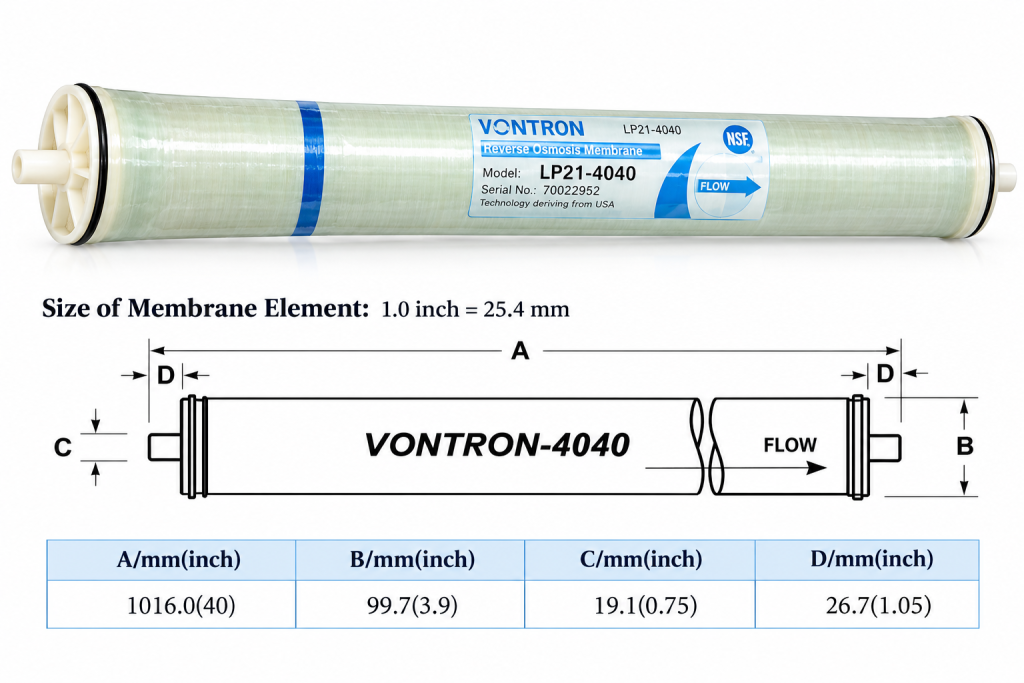
In the technical drawing, dimension A represents the overall length of the membrane element, while dimensions B, C and D represent the corresponding dimensional characteristics shown in the illustration.
When selecting a pressure vessel, it is necessary to ensure that the vessel dimensions and configuration are compatible with the membrane element.
4. Technical Specifications of the VONTRON LP21-4040
The specifications below are compiled directly from the VONTRON technical documentation provided for the LP21-4040 model.
4.1. Performance Specifications
| Parameter | VONTRON LP21-4040 |
|---|---|
| Model | LP21-4040 |
| Active Membrane Area | 90 ft² (8.4 m²) |
| Average Permeate | 2,400 GPD (9.1 m³/day) |
| Stable Rejection Rate | 99.5% |
| Minimum Rejection Rate | 99.3% |
The permeate value stated in the documentation is an average value. VONTRON also specifies that the permeate flow of an individual membrane element has a tolerance not exceeding ±15% of the nominal value.
Therefore, when evaluating the actual flow rate of an individual membrane, operating conditions and product tolerance should be considered rather than relying solely on the nominal value.
5. Testing Conditions of the LP21-4040 Membrane
RO membrane performance is directly affected by feed water quality and operating conditions. Therefore, rejection and permeate performance should be evaluated together with the testing conditions specified by the manufacturer.
For the VONTRON LP21-4040, the published testing conditions include:
| Testing Condition | Value |
|---|---|
| Testing Pressure | 225 psi (1.55 MPa) |
| Testing Solution Temperature | 25°C |
| Concentration of Testing Solution – NaCl | 2,000 ppm |
| pH of Testing Solution | 7.5 |
| Recovery Rate of Single Element | 15% |
The 99.5% rejection and 2,400 GPD values should therefore be understood in conjunction with the above testing conditions.
In actual operation, temperature, salt concentration, feed flow rate, recovery and feed water quality may all affect membrane performance.
6. Operating Conditions of the LP21-4040 Membrane
To maintain membrane performance and service life, the membrane element should be operated within the manufacturer’s specified limits.
6.1. Maximum Working Pressure
Maximum Working Pressure: 600 psi (4.14 MPa)
This is the maximum working pressure specified by VONTRON for the LP21-4040.
During RO system design and operation, the pressure should be controlled according to actual operating conditions and must not exceed the membrane element’s technical limit.
6.2. Maximum Feed Water Flow
Maximum Volume of Feed Water: 16 GPM (3.6 m³/h)
The feed water flow rate should be controlled to avoid unsuitable hydraulic conditions for the membrane element.
6.3. Maximum Feed Water Temperature
Maximum Temperature of Feed Water: 45°C
Feed water temperature is an important parameter for RO membranes. Therefore, the feed water supplied to the LP21-4040 should be controlled within the limit specified by VONTRON.
6.4. SDI₁₅
Maximum Feed Water SDI₁₅: 5
SDI is one of the parameters used to evaluate the fouling potential of feed water toward RO membranes.
For the LP21-4040, the documentation specifies:
Maximum SDI₁₅ = 5
Therefore, the pretreatment system should be designed and operated to bring the feed water quality within the appropriate range before the water enters the RO system.
7. Feed Water pH Range
VONTRON specifies two different pH ranges for continuous operation and chemical cleaning.
Continuous Operation
pH: 2–11
This is the specified feed water pH range for continuous operation according to the technical documentation.
Chemical Cleaning
pH: 1–13
During chemical cleaning, the specified pH range is extended to:
pH 1–13
However, chemical cleaning should be performed according to a procedure appropriate for the type of fouling, membrane condition and manufacturer’s technical instructions.
The chemical cleaning pH range should not be interpreted as the continuous operating pH range of the membrane element.
8. Chlorine Control in Feed Water
Another important parameter specified by VONTRON is:
Residual Chlorine Concentration of Feed Water: <0.1 ppm
The feed water supplied to the membrane should be controlled to a residual chlorine concentration below 0.1 ppm, according to the product documentation.
This requirement should be considered when designing the RO pretreatment system, particularly for systems using chlorine or sodium hypochlorite for disinfection.
Controlling feed water quality before it enters the membrane element is an important factor in ensuring that the VONTRON LP21-4040 operates within the manufacturer’s specified conditions.
9. Pressure Drop of the Membrane Element
The technical documentation specifies two pressure drop limits:
For a Single Membrane Element
Maximum Pressure Drop:
15 psi (0.1 MPa)
For a Pressure Vessel Containing 6 RO Membranes
Maximum Pressure Drop:
50 psi (0.34 MPa)
Pressure drop is a parameter that should be monitored during RO system operation. Changes in pressure drop can be evaluated together with other operating parameters to assess the operating condition of the system.
When pressure drop increases, the operator should check the operating conditions, feed water quality, pretreatment system and condition of the membrane elements.
10. Applications of the VONTRON LP21-4040 RO Membrane
According to VONTRON’s LP series documentation, the VONTRON LP membrane is designed for desalination of various water sources.
10.1. Surface Water Treatment
The LP series can be used for surface water sources, provided that the feed water is appropriately pretreated before entering the RO system.
VONTRON’s documentation refers to surface water with a NaCl concentration of ≤10,000 ppm within the application scope of the LP series.
10.2. Groundwater Treatment
Groundwater is one of the water sources listed by VONTRON for the LP membrane series.
Depending on the characteristics of the source water, an appropriate pretreatment system should be selected before the RO process.
10.3. Tap Water and Municipal Water
The LP series is also introduced for:
- Tap water
- Municipal water
These water sources can be supplied to an RO system after meeting the required feed water quality conditions.
10.4. Industrial Pure Water Production
One of the main application groups of the LP series is the treatment of water to produce industrial-purpose pure water.
The RO membrane can serve as a desalination and dissolved-substance removal stage before subsequent water treatment processes.
10.5. Boiler Water Replenishment
VONTRON’s documentation also states that the LP series can be used for:
Boiler water replenishment in power plants
In this application, the RO membrane helps treat feed water before the water enters subsequent treatment stages of the boiler water system.
10.6. Brackish Water Treatment
The LP series is also introduced for certain brackish water applications, including water sources with relatively high salt concentrations.
In addition, the documentation mentions applications involving the treatment of high-concentration saline wastewater and the production of water for beverage applications.
11. Flushing and Commissioning of the LP21-4040 Membrane
A new RO membrane should be properly flushed and prepared before being put into normal operation.
According to the VONTRON documentation, the following procedures should be performed during initial commissioning:
Step 1: Low-Pressure Flushing
Perform low-pressure flushing for approximately 15–25 minutes.
The purpose is to flush and prepare the membrane element before switching to subsequent operating conditions.
Step 2: High-Pressure Flushing
Then perform high-pressure flushing for approximately 60–90 minutes during initial commissioning.
The documentation requires the permeate flow during this process to be no less than 50% of the designed flow rate.
Step 3: Discharge Initial Permeate
During the first hour after system start-up, the permeate and condensed water produced should be discarded.
This is an important consideration when commissioning a new membrane element.
12. Storage of the VONTRON LP21-4040 Membrane
RO membranes require appropriate storage conditions to maintain the condition of the membrane element before use or during long-term system shutdown.
According to VONTRON’s documentation:
12.1. The Membrane Must Remain Wet
After use, the membrane element should remain wet.
The membrane should not be allowed to dry out during storage or system shutdown.
12.2. Preservative Solution
For long-term shutdown, the documentation recommends immersing the membrane element in a protective solution prepared with:
1.0% sodium hydrogen sulfite
The solution should be prepared using RO-filtered water.
12.3. Winter Conditions
The documentation also notes that under winter conditions:
10% glycerin antifreeze
is required when necessary for storage purposes.
The selection and preparation of the preservation solution should follow the manufacturer’s instructions.
13. Important Considerations When Using the VONTRON LP21-4040
To ensure that the membrane element operates under the intended design conditions, several factors should be carefully considered.
13.1. Control Feed Water Quality
The following parameters should be controlled within the limits specified by VONTRON:
- SDI₁₅
- pH
- Residual chlorine
- Temperature
- Feed water flow rate
13.2. Do Not Exceed the Working Pressure
The operating pressure must not exceed:
600 psi (4.14 MPa).
At the same time, the pressure drop of the individual membrane element and pressure vessel should be controlled according to their respective limits.
13.3. Do Not Use Chemicals Arbitrarily
VONTRON’s documentation notes that during storage and operation, chemicals that may adversely affect the membrane element must not be added arbitrarily.
For chemical cleaning, an appropriate procedure and chemicals should be selected according to the membrane requirements.
13.4. Monitor Permeate Flow
The published average permeate flow of the LP21-4040 is:
2,400 GPD (9.1 m³/day).
During system monitoring, changes in permeate flow should be evaluated together with actual operating conditions rather than relying on a single nominal value.
14. VONTRON LP21-4040 Technical Specification Table
| Parameter | Value |
|---|---|
| Model | LP21-4040 |
| Membrane Type | Low Pressure Aromatic Polyamide Compound |
| Active Membrane Area | 90 ft² (8.4 m²) |
| Average Permeate | 2,400 GPD (9.1 m³/day) |
| Stable Rejection Rate | 99.5% |
| Minimum Rejection Rate | 99.3% |
| Testing Pressure | 225 psi (1.55 MPa) |
| Testing Temperature | 25°C |
| Testing NaCl Concentration | 2,000 ppm |
| Testing pH | 7.5 |
| Single Element Recovery | 15% |
| Max. Working Pressure | 600 psi (4.14 MPa) |
| Max. Feed Water Flow | 16 GPM (3.6 m³/h) |
| Max. Feed Water Temperature | 45°C |
| Max. Feed Water SDI₁₅ | 5 |
| pH – Continuous Operation | 2–11 |
| pH – Chemical Cleaning | 1–13 |
| Residual Chlorine | <0.1 ppm |
| Max. Pressure Drop – Single Element | 15 psi (0.1 MPa) |
| Max. Pressure Drop – Vessel with 6 RO Membranes | 50 psi (0.34 MPa) |
| Length A | 1,016.0 mm (40″) |
| Dimension B | 99.7 mm (3.9″) |
| Dimension C | 19.1 mm (0.75″) |
| Dimension D | 26.7 mm (1.05″) |
15. ANCES – VONTRON RO Membrane Supply and Water Treatment Solutions
For industrial water treatment systems, selecting a membrane element requires consideration not only of permeate flow and rejection rate but also of source water quality, operating pressure, recovery, SDI, temperature, pH and pretreatment conditions.
The VONTRON LP21-4040 is a Low Pressure RO Membrane element developed for desalination and the treatment of various water sources, including surface water, groundwater, tap water, municipal water and certain brackish water applications.
With an active membrane area of 8.4 m², an average permeate flow of 9.1 m³/day and a stable rejection rate of 99.5% under the manufacturer’s specified testing conditions, the LP21-4040 can be integrated into RO systems for industrial pure water production and other suitable water treatment applications.
ANCES supplies and provides technical consultation for VONTRON RO membranes, supporting the selection of membrane elements based on system requirements and actual feed water conditions.
When selecting the VONTRON LP21-4040, all system parameters should be checked against the technical limits specified in the manufacturer’s documentation to ensure that the membrane element is operated under the intended design conditions.